




The static screen is dead. With AI, digital design is moving past the era of the fixed interface. We are structuring underlying systems instead of just building destinations.
You know who does that very well? Game designers.

AI Key Takeaways
Digital products sit on two axes, static to dynamic and triggered to ambient, and the open quadrant is ambient dynamic: interfaces that reorganize themselves from accumulated behavioral signal without the user asking.
In that quadrant the primary design artifact is the rule set, which signals accumulate, how they are weighted, and what the system produces when they cross a threshold.
Game design has worked this way for decades, treating feedback as a product of system state, which makes it the discipline to study for this era of product design.
Accessibility becomes an output the system produces from observed behavior instead of a setting the user has to know about and configure, which breaks WCAG-style certification because there is no single state to audit.
Static design serves a primary audience and degrades outward; ambient dynamic design holds the primary experience intact and extends range by adding rules.
The design community mostly discusses AI in terms of tools: faster prototyping, generated copy, and automated layouts. That’s surface-level. The deeper transition, too little discussed, involves the nature of the output. When an interface is powered by an invisible intelligence layer, we are being asked to design rule-based environments rather than fixed screens. Game design mastered this form of system architecture decades ago, making it the essential discipline to study for this next era of product design.

Static vs. Dynamic design / Triggered vs. Ambient AI
Most digital products operate over two axis:
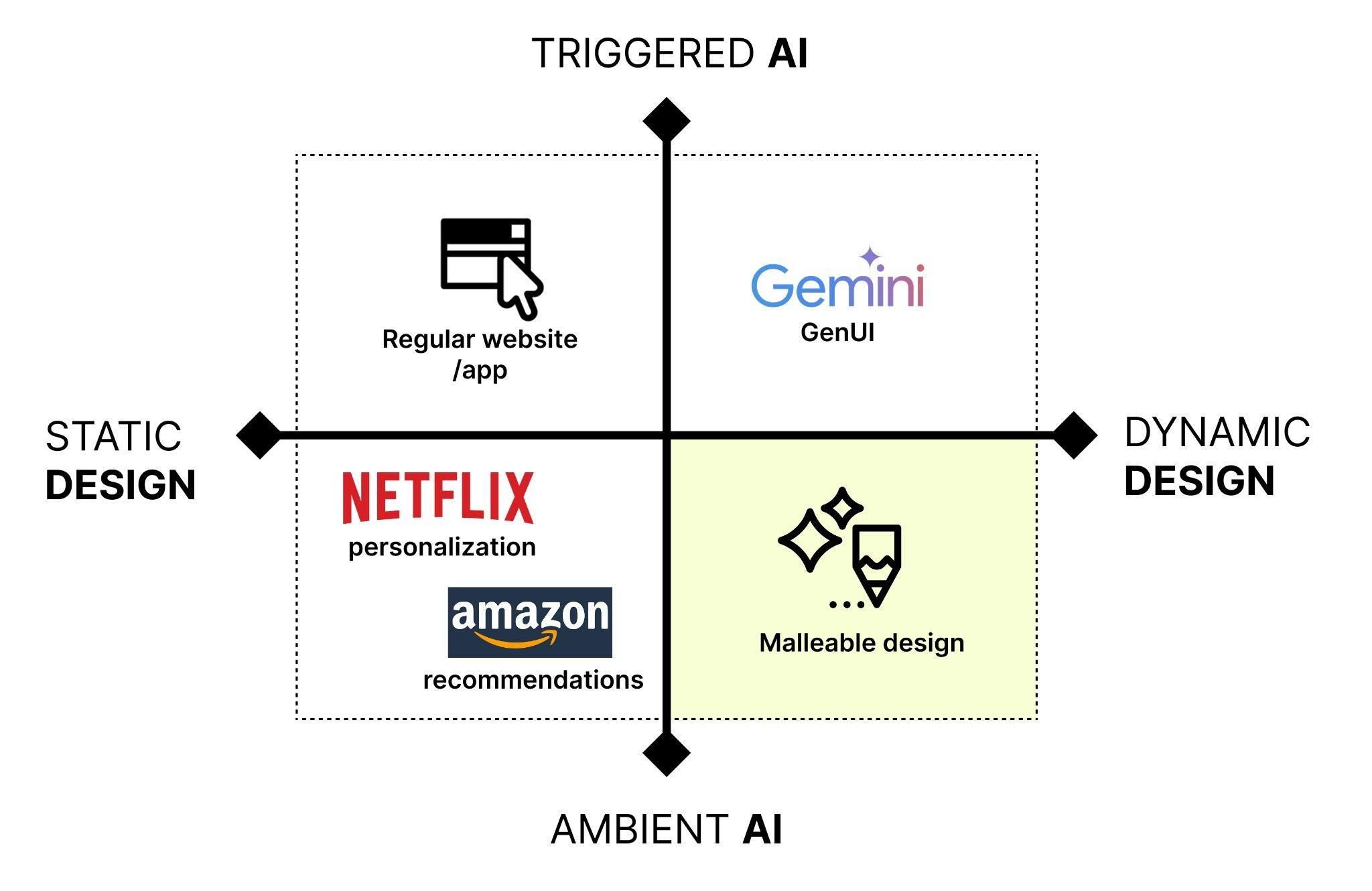
One axis runs from static to dynamic: whether the interface structure stays fixed or reorganizes.
The other runs from triggered to ambient: whether that response requires explicit user action or operates on observed context.
Static and triggered covers most of the web.
Static and ambient includes recommendations and algorithmic feeds.
Triggered and dynamic is generative UI.
Ambient and dynamic is the space, the last quadrant, we are going to talk about.
The first is static and triggered. A user clicks, taps, or submits, and the interface responds. The structure remains identical for everyone. This has been the default model for websites and apps since the beginning.

In 2026, approximately 80 percent of content discovery on the platform is driven by these recommendations rather than manual search. By leveraging the fact that the human brain processes images 60,000 times faster than text, Netflix turns the interface into a proactive salesperson that identifies user intent before a single word is typed.

The second mode is static and ambient: personalization. The system continuously observes behavior and surfaces different content, like a recommendation, an algorithmically selected thumbnail, or a feed ordered by predicted relevance. The interface container stays fixed while the content changes. Take Netflix’s hero image and Amazon’s recommendations. The layout is identical for every user; the algorithm works beneath it to propose custom content that influences engagement.

Generative UI is a third, emerging mode: dynamic and triggered. A user asks a question, and the system builds an interface in response (a simulation, a custom tool, or a visual experience assembled on the fly). The output is genuinely dynamic, but it requires a prompt, with someone actually querying the model.
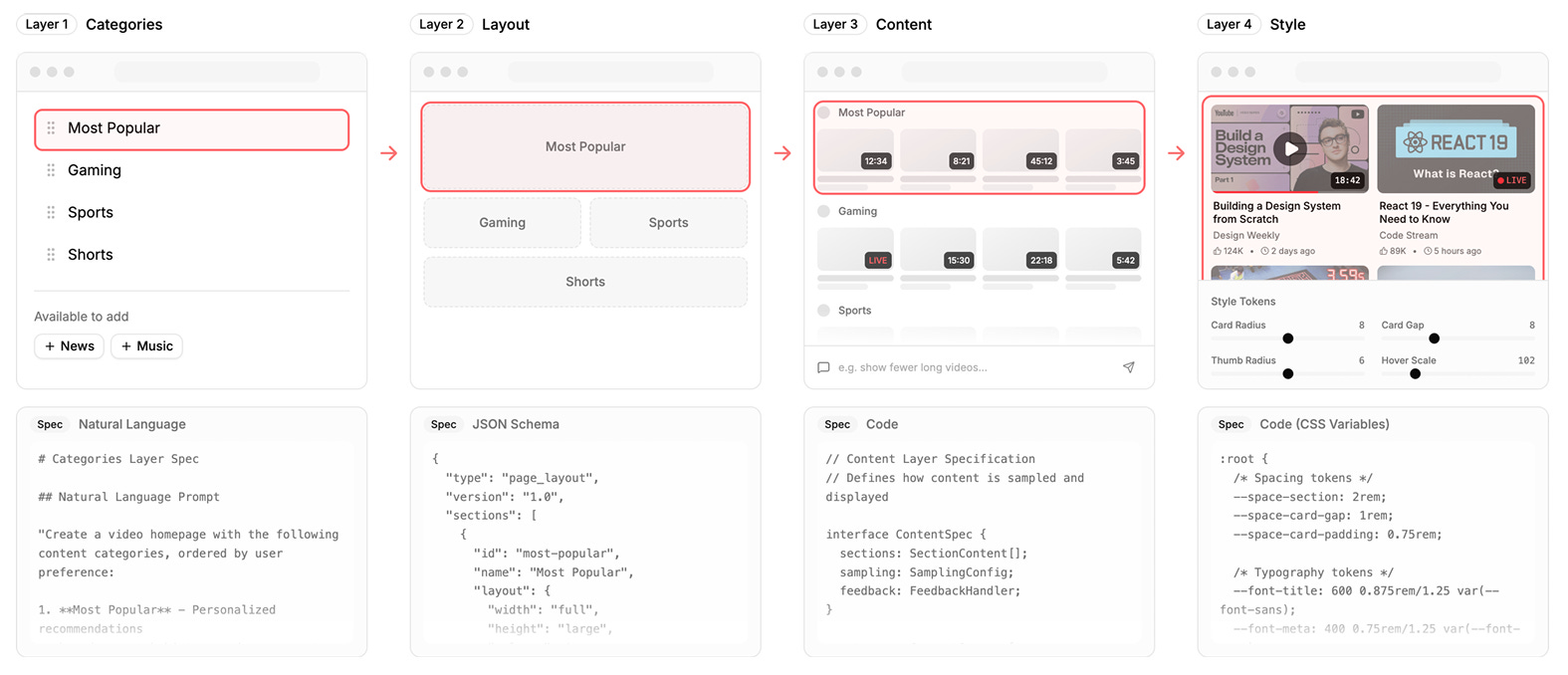
“Figure 1: We present Gradual Generation as a method for designing customizations in generative UI applications. Gradual Generation proposes UI/UX designers to organize UI customizations into multiple intermediate layers that AI progressively loads during interface generation, enabling users to discover and access customizations by rewinding to earlier stages.”
The fourth mode, dynamic and ambient, has been named Gradual Generation of UI, or Malleable Software / design. The interface reorganizes itself continuously and proactively based on accumulated behavioral signals, without user initiation. It is neither a selection from existing variants nor a response to a query. But instead, it is an ongoing, invisible calibration to who is using the product and how.

A-to-I
Consider a California two-spot octopus moving into colder water. Unnatural for it. Its DNA has not prepared it for this. Cold slows down the gates that reset nerve cells after they fire. When those gates lag, the nerves cannot fire again quickly enough, and the animal’s ability to move, hunt, and respond begins to fail.
Within hours, the octopus begins editing its genetic messengers, its RNA, at over 13,000 sites. First, the proteins that physically carry cargo along nerve fibers are reconfigured to move faster, compensating for the slowdown caused by the cold. Second, the proteins that trigger chemical signals between nerves are reconfigured to alter their sensitivity, restoring the exact timing of the nervous system. The system works again. When the water warms, the edits reverse.

The genome never changed and the same DNA remains in every cell. This demonstrates a system capable of reading the environment, identifying what was failing, and modifying its own components to compensate. That intelligence layer, rather than a simple biological feature, is the essential condition for survival and thriving in adverse environments.

What it means to design for ‘Ambient dynamic’
On a product detail page, a user lands, scrolls past the hero, opens the reviews, closes them, opens them again, zooms into the second image, compares two alternative products, and returns. In a static product, that behavior goes into a log. In an ambient dynamic product, it becomes a design instruction.
The information architecture reorganizes around demonstrated priority. A buyer who always checks materials and provenance before price receives a hierarchy reflecting that sequence. This happens because the system accumulated enough signal to act, not because the user set a preference. A spec-first buyer receives a technically rendered product. A buyer who responds to lifestyle context sees the product placed in one. It is the same page presenting a different argument.
In a dynamic experience, hero imagery adapts to inferred visual preference instead of selecting from a fixed set of existing assets. Voice and tone shift register based on observed behavior rather than assumed demographics. Onboarding dissolves as competence is demonstrated. Navigation reorganizes around workflow without requiring manual configuration. The shape and register of assistance changes with the user profile. A first-time earner on a financial dashboard receives proactive bubbles surfacing before confusion arrives, avoiding a chatbot waiting to be asked.
The system keeps score. None of this requires the user to signal intent.

Rules, not responses
A static product designer thinks about feedback, like hover states, click states, error messages, confirmations. Each one is a response to a discrete action, fully predictable, designed individually. This process relies on a collection of defined responses rather than a holistic system.
In comparison, a game designer thinks about the system first. The feedback is what the system produces at a given state: the same action produces different feedback depending on where the player is, what they have accumulated, what thresholds they have crossed. You cannot design the feedback without understanding the rules that generated it.
An ambient dynamic product works the same way: now what a user sees is a consequence of accumulated score across observed signals. You cannot design that state the way you would design a hover state. You can only design the rules and thresholds that produce it. A designer trained on static products who approaches this work at the level of responses is working at the wrong level of abstraction.
The rules define which signals accumulate, how they are weighted, and what the system produces when they cross a threshold across layout, information architecture, imagery, voice, and tone.
The model keeps score. The experience is a consequence of that score, not something composed directly.
That rule set is the primary design artifact. It needs to be mapped, documented, and maintained. It can grow over time without breaking what exists, adding new signals, new surfaces, new thresholds as research surfaces, caring for new users and new behaviors.

Accessibility as a native output
The current accessibility model depends on a user recognizing they have a need, knowing a setting exists, finding it, and configuring it. For many people, one of those steps fails.
A system keeping score on behavioral signals doesn’t need self-identification. Slower navigation, repeated re-reading, friction at specific interaction types are signals. Larger text, simplified language, more confirmatory feedback are outputs the system produces when those signals accumulate past a threshold. The experience adjusts automatically for individuals who would never consider configuring settings manually.
This also breaks the current model of accessibility certification. Obviously, WCAG and similar frameworks were written for static products: a fixed set of requirements that your fixed interface either meets or doesn’t. A product that adapts differently for every user has no single state to audit. How do you certify something that is, by design, never the same twice?

To infinity, and beyond
The moment adaptation becomes proactive and dynamic, a product is in the fourth quadrant. What grows from there is depth: how many signals the system reads, how many surfaces it adapts, how rich the rule set is.
Static design serves a primary audience and extends to others in a degraded form. Dynamic, ambient design keeps the primary experience intact and builds range outward from it. Research shifts from validating what exists for a known audience to encountering more users and uncovering new behaviors. These findings translate into new rules for the system to act upon. Each round expands the product’s capabilities without disrupting what already works.
“GenUI becomes expressive through a set of layered design decisions embedded in intermediate UIs, instead of unconstrained generation.”
- Min, B., Huang, Z., Jiang, P., & Xia, H. (2026, January 25). Gradual generation of user interfaces as a design method for malleable software. University of California San Diego. https://arxiv.org/pdf/2601.17975
This requires a complete reversal of how we think about communication. In static design, we orchestrate signals moving outward from the screen to the user. In GenUI / Malleable design, we design for signals moving inward from the user to the machine. This demands both systematic intelligence and a design intelligence for systems. Leveraging this model means codifying the underlying rules that allow a machine to read behavioral signals and adapt every layer of the experience: from information architecture and layout to UI, text, visuals, and heuristics.
Thinking in terms of systems, writing rules, and keeping score is the native language of game design. Applying this mindset to products means leveraging AI not as a reactive, visible tool, but as a proactive, invisible layer of intelligence. Ultimately, product design must shift to system design, to become intelligence design.
NA: AI-assisted tools were used for transcription, reference formatting, and language editing. All intellectual content and conclusions remain solely the author’s.
Very interesting. Its exactly why I tend to look at Game UI for inspiration as a Product Designer. They are free from the design rules we follow over and over, and tend to be much more creative when it comes to system understanding and responses it can give to user. Great article ☺️
i actually used your article with codex to help improve my games UI!