



This article is a deep-dive analyzing the concept of privacy for the new generation of consumers, and it directly follows up my recent one about what I believe is a successful campaign from Meta for the launch of their Kylie glasses.
Because, yes, the Kylie glasses campaign works, and it’s because the cultural ground was already prepared. Prepared by whom, over how many years, and at whose expense?

AI Key Takeaways
Meta’s glasses meet a generation that has never known unrecorded public space. Front-facing cameras, story formats, doorbell networks, and twenty seasons of surveillance-as-entertainment formed the baseline before the hardware arrived.
The behavioral science is settled: creepiness is a movable threshold, systematically lowered by familiarity, social proof, and perceived value exchange, and the policy conversation runs about three phases behind the behavior.
The misuse pipeline predates the product. The Manchester nightlife genre established non-consensual first-person filming of women as a content category, with an audience and a paywall, while the camera was still a phone.
China shows the destination: 62% of urban consumers comfortable paying with their face, 80% approving of recognition infrastructure. The open question is the path, and Meta is testing whether consumer desire can pave it faster than state mandate did.
The launch’s normalization vector is women, the demographic with the most documented exposure to the product’s risks. That inversion, and the question of who gets to set the baseline for public space, are the real stakes.
Everyone around you hates it. But the easy explanation for the Kylie glasses campaign’s success is that Meta ran a very good campaign. The structural partnership, the first-impression strategy, the inherited POV format, the point-by-point inversion of Google Glass. But “good campaign” explains the vehicle, and the vehicle was driving on a road someone else spent twenty years building. The real explanation is generational.

If you care about privacy, you’re too old for the Meta glasses

Consider what the world has looked like from inside the life of Kylie Jenner’s core follower, someone born around 2007. Her childhood was posted by her parents before she could consent to it. Her school had cameras, her neighbors had doorbells that record the street, her social life has been conducted through front-facing lenses and story formats since before adolescence, and every group chat she has ever written in can be screenshotted into a public exhibit. The entertainment of her formative years was the reality format, and its most successful graduate is the woman whose voice now ships inside the glasses:
Jenner grew up on camera, in a household that converted continuous observation into one of the most valuable media properties of its era, and then converted the watching into a beauty empire.

For this cohort, “would you consent to being recorded in public?” has never been a prospective question. It describes the world as they found it. Privacy researchers keep measuring the gap between what people say about surveillance and what they accept in practice, and the gap keeps being read as hypocrisy or apathy. Biography is the better explanation: the alarm the older cohort expects to hear was calibrated by a world this cohort never lived in. Google Glass failed because it violated a baseline. The Kylie glasses succeed because their buyers never formed one. You cannot trigger an expectation of privacy that was never wired.
That is why the campaign’s first-impression strategy works at all. There is no stigma to overcome in the target demographic, and no memory of unwatched public space to appeal to. The critics writing warnings are, in the most literal sense, writing to a different generation.
If you care about privacy, you’re too old for the Meta glasses.
The threshold is movable
HCI and privacy research, creepiness is defined as an affective response, an alarm that fires when personal information is collected or used in a way that violates expectation. Two properties matter. It is an alarm, a felt response that arrives before any evaluation. And it is threshold-dependent: the same technology, the same data collection, can fire the alarm or not depending on context, expectation, and perceived value exchange.
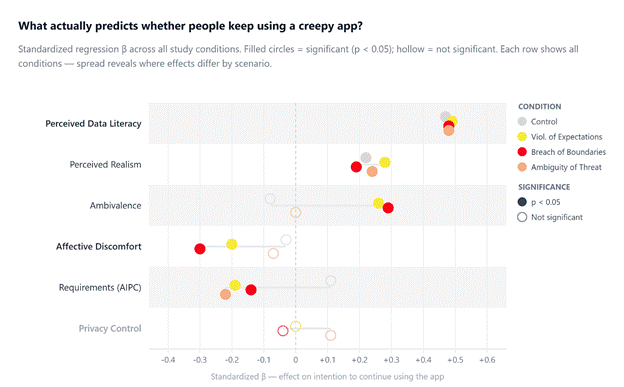
Both properties are exploitable, and the exploitation has been documented. A 2022 CHI paper with an unimprovable title, “Still Creepy After All These Years,” found that users systematically normalize perceived creepiness through repeated exposure: the discomfort is real at first contact, then gets suppressed through rationalization, habituation, and resignation, while the underlying data practices stay exactly as invasive as they were. The researchers call it affective discomfort normalization. The alarm simply goes quiet.
Downstream of habituation sits the state the literature calls privacy cynicism: the settled belief that data collection is pervasive, inevitable, and beyond individual influence. Cynics know they are being surveilled and change nothing, because helplessness has been internalized as realism. A population that spends its life inside Meta’s platforms arrives at the glasses pre-processed: for the resigned, one more sensor on the stack registers as no marginal harm at all.
The campaign’s behavioral funnel runs straight through this machinery.
Aspiration first: Kylie wants this. Social proof second: the creators I follow wear it. Habituation third: it’s part of how people dress. Resignation last: everyone has them now.
Each stage has its own psychological mechanism, and the policy conversation reliably runs about three stages behind the behavior, which is why there is still no coherent legal framework for wearable recording two years into its commercial life.
The reframe I find most instructive: the voice. The glasses do not announce that Meta is recording your surroundings. They say “Rise and shine” in a warm, familiar voice each morning. Surveillance coded as care produces a categorically different emotional response than surveillance coded as monitoring, and I’ve written about the general version of this mechanism: trust runs on scaffolding and social signals, on the fast pathway that evaluates a face or a voice, and almost never on an audit of what the system actually does. The Kylie voice is trust scaffolding bolted directly onto a sensor array.
The pipeline existed before the product
If the discomfort machinery explains the buyers, the Manchester case explains the other side of the lens. In 2024, Greater Manchester Police arrested a man in connection with videos of women filmed on nights out in Manchester city centre, believed to be the first UK arrest of its kind. The videos, titled “Manchester nightlife” and “Liverpool nightlife,” drew millions of views on TikTok and a comment culture to match, and the investigation surfaced a paywalled tier containing suspected non-consensual intimate content. The police called the phenomenon “a very new and complex issue,” which was true legally and false behaviorally: as content, the genre was mature. Established audience, established distribution, established monetization, running for years.

The device was a phone. Every element of that pipeline transfers to glasses unchanged except one: the visibility of the act. A phone held at chest height announces itself, and the announcement is what let bystanders notice, complain, and eventually get someone arrested. The glasses’ contribution to the genre is subtraction. They remove the last remaining friction in non-consensual filming, which was being seen doing it, and in the same motion they raise the evidentiary bar for ever proving it happened.
This is the fact that should sit at the center of every analysis of this launch and almost never does. Meta inherited a functioning misuse pipeline the way it inherited the POV format: pre-built, pre-monetized, waiting for better equipment.
The destination is already open for business
Skeptics of normalization arguments usually ask for the endpoint: normalized into what, exactly? The answer has an address. In China, facial recognition has operated in commercial retail at scale since roughly 2016. A Chengdu bookstore admits customers through a face-scan gate. Retail systems read up to ten data points per face, including mood, and adjust recommendations in real time. Smile-to-pay is a checkout option, and the survey data is unambiguous: 62% of urban Chinese consumers report being happy to pay with biometric data, and 80% of surveyed internet users approve of the recognition infrastructure around them, with approval rising with education, the inverse of the Western gradient.

It doesn’t feel like intrusion there, and it has nothing to do with the hardware. The shop scanner satisfies every condition that makes surveillance read as service: it is fixed and visible, you entered its space voluntarily, the value exchange is immediate and legible, the counterparty is a brand you chose, and you can leave. A stranger’s glasses in a shared public space fail every single one of those conditions: mobile, invisible, no consent, no exchange, no exit, unknown intent. By the standards of the behavioral research, glasses should read as the creepiest deployment of ambient recording yet shipped.
But the conditions are cultural, and expectations recalibrate. This is Helen Nissenbaum’s contextual integrity operating at civilizational scale, the same framework I used to argue about AI confidants: a privacy violation is a context crossing, and if you re-engineer the context, the crossing stops registering. China recalibrated through state infrastructure first and commerce second, decades of it, until ambient scanning became the assumed texture of public space. Meta is running the experiment in reverse: culture first, through desire and identity and a beauty mogul’s voice, before any regulatory framework exists to define the rules. It is the riskier path, which is exactly why the campaign has to move fast and stick hard.
Marketed through women
Smart-glasses adoption has historically skewed male, and there is little evidence Meta expects that to change. The campaign targets women anyway, because the campaign’s real product is permission.
Influential women certify the object as socially safe: fashionable, feminine, nothing to do with the tech bro in the corner.
Once certified, the object crosses over to everyone who shares those social spaces. Women are the trust infrastructure of this launch, and the marketing copy completes the move with a reframe of real precision: the glasses are pitched as a way to record back, casting the wearer as an agent of surveillance reciprocity in a world already filming her.
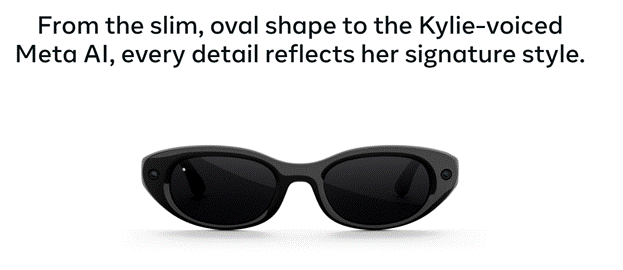
Social proof, as the peer group adopts. Identity aspiration, as ownership signals alignment with a desirable self. Privacy cynicism, sharpened here by the fact that women are already the most surveilled demographic on every axis: by platforms, by advertisers, by partners, by strangers with phones in nightclubs. For someone whose baseline exposure is already that high, the marginal sensor genuinely may not register. And over it all, the care-coded voice of a woman who made being watched into an empire.
The demographic recruited to normalize the always-on camera is the demographic the Manchester pipeline points it at. If the narrative solidifies that women were used as the normalization vector for a product they disproportionately suffer from, the damage extends to the brand’s relationship with its largest demographic. That is the risk stated as brand exposure. What would the women in the Manchester videos?
Who sets the baseline
Who gets to set the expectation baseline for shared space? In China, the state set the baseline, openly, with the machinery of state legitimacy behind it. In the West, the emerging answer is: whoever reaches scale first. Meta’s campaign, which is merely excellent, is just the current claimant. A production commitment of 20 to 30 million units a year is a claim on the right to define what it means to stand in a room with someone wearing glasses, filed before any democratic institution has ruled on the question, in the confident expectation that institutions will end up writing rules for a world already built.
Somewhere ahead is the trigger event: the stalking case, the intimate recording, the incident that momentarily reconnects the fashion object to its sensor array in mainstream consciousness. It is near-certain in occurrence and unpredictable in timing, and the standard analysis treats it as the moment the normalization could unravel.
I’d bet the other way.
Every month of the funnel moves more of the population past the threshold where the trigger can reach them, and the generation that matters most was past it before the product shipped.
The most effective normalization vector for surveillance hardware turned out to be the demographic with the most documented reasons to refuse it. That sentence should be shocking. Still. The engine of this launch is that, for the audience it was engineered for, it isn’t even surprising.
They were raised inside the panopticon, and Meta is simply the first company to sell them the guard tower as an accessory.
NA: AI-assisted tools were used for transcription, reference formatting, and language editing. All intellectual content and conclusions remain solely the author’s.
This is well written and I like how you have structured your thoughts and analysis. I like your comment “China is the destination” because although I’m not sure they will get us there, it’s clear the tech oligarchy is ready to abandon American values and is deeply envious of the Chinese system and culture. It’s almost like the “Chinese democracy” meme failed and that meant it had to be replaced by “American police state” for capitalism to keep working.
I’ve written two pieces on SmartGlasses, here is one of them: hope you like it: https://ideachemistry.substack.com/p/nine-future-scenarios-for-the-coming-war-over-smartglasses