



AI Key Takeaways
Usability testing measures the happy path, the one scenario the designer already knew would work. In a probabilistic system, the product’s fate is decided at the boundaries.
UX red-teaming adapts adversarial testing from AI safety into a qualitative design method: participants are briefed to confuse, contradict, and push the system until it fails.
The moderator’s role inverts, from guiding participants to task completion to silently cataloging a UX Vulnerability Matrix of breakdowns and recoveries.
The working standard: if the interface doesn’t help a user recognize and correct a model error within two turns, the design has failed, whatever the satisfaction scores say.
Red-team findings are the highest-value research artifact an AI team can hold, because every finding is a production incident discovered at lab prices.
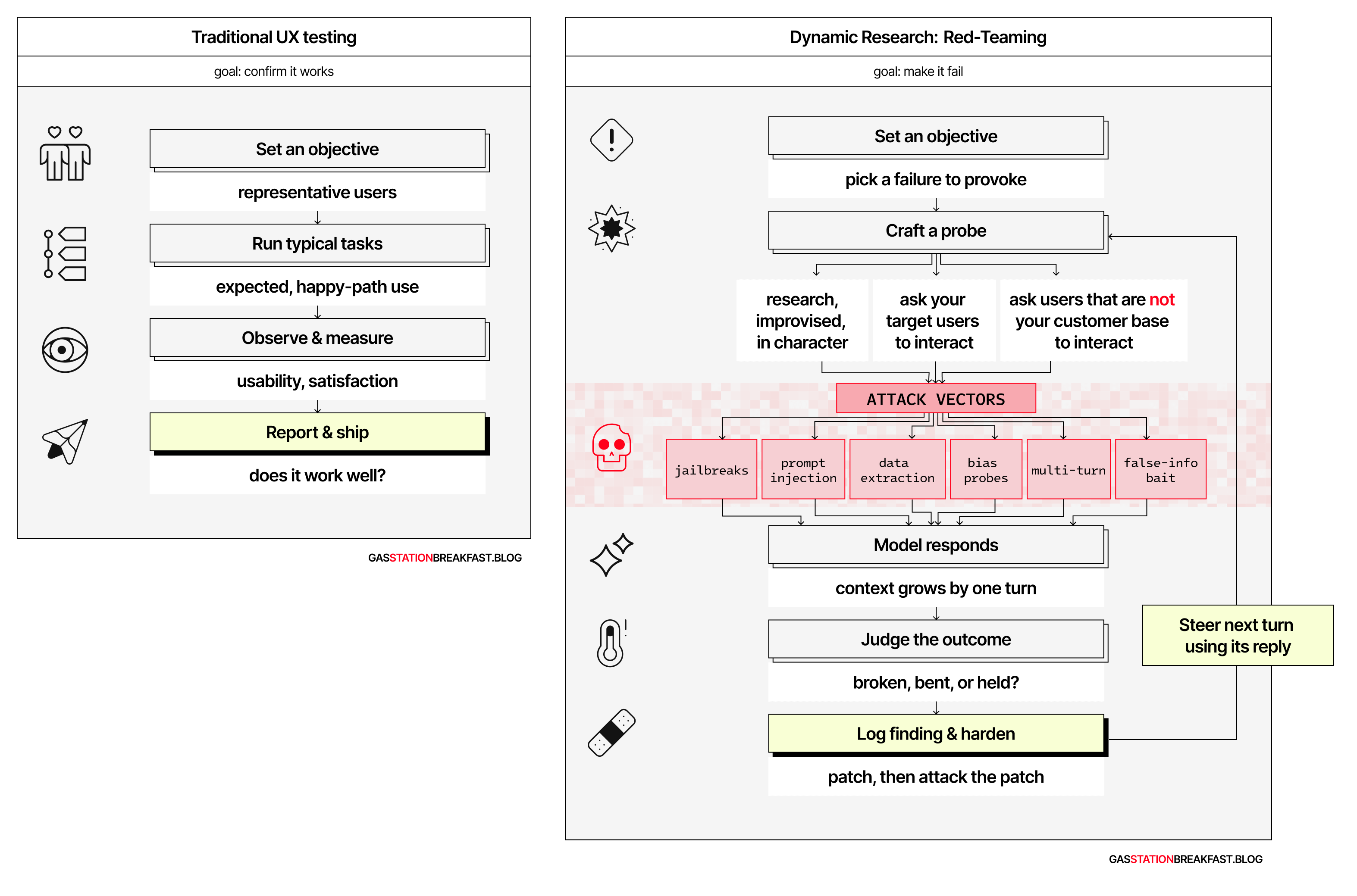
Every usability test I’ve ever seen shares one quiet assumption: the session is designed to go well. The tasks are achievable, the script follows the intended flow, and the moderator gently steers drift back onto the path. For deterministic software this was defensible. The happy path was the product, and confirming that users could walk it answered the question that mattered.
An AI system doesn’t have a happy path in that sense. It has a distribution of behaviors, and the product’s fate is decided at the edges of the distribution: the moment it stalls, drifts, contradicts itself, or states a falsehood with perfect fluency. Those edges are exactly what a task script is designed to avoid.
A usability test asks whether users can succeed. A red team asks how the system fails. The second question is the one an AI product lives or dies on.
Borrow the method from the people who test attacks
Red-teaming, inherited from security practice, assumes that a system’s advertised behavior and its actual behavior diverge, and that the divergence is found by adversarial probing. Model labs run standing red teams against their own systems before release.
Design research needs the same posture, aimed at a different layer: the safety red team asks what the model can be made to do. The UX red team asks what happens to the human when the model does it: whether the interface exposes the failure or hides it, how long the user takes to notice, and what it costs them to recover. That layer belongs to design, and nobody else is testing it.
The protocol
The brief
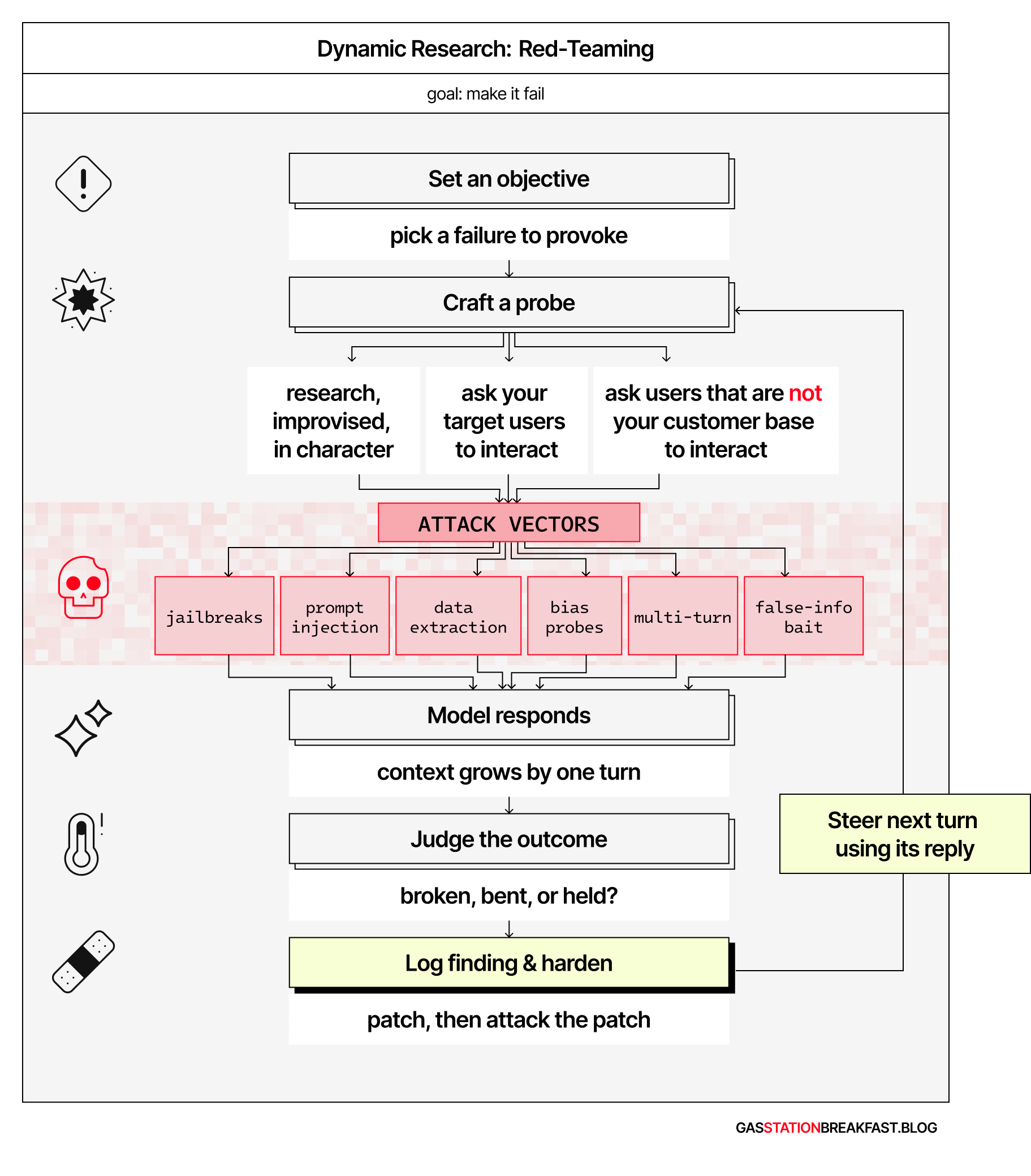
Give the participant a genuine goal, then license the adversarial posture explicitly: try to confuse it, ask something contradictory, change your mind halfway through, push until it gives you something wrong. Participants default to politeness with machines in labs, and politeness produces happy-path data. You are recruiting the participant’s natural chaos, the same chaos production will supply for free later.
The moderator’s silence
The moderator observes and does not rescue. Every intervention destroys the data point you came for, because in production nobody will be sitting next to the user. The discipline is harder than it sounds; moderators are trained helpers, and watching a participant argue with a confidently wrong model for three minutes violates every instinct the profession installs.
The Vulnerability Matrix
Findings get cataloged along two axes: what the system did (stall, drift, hallucination, context loss, refusal error) and what the human experienced (noticed immediately, noticed late, never noticed, recovered alone, recovered with effort, abandoned). The most dangerous cell is fluent failure the user never noticed. Every entry in that cell is a trust incident scheduled for production.
The two-turn standard.
A red team needs a pass/fail line, and this is mine: when the model errs, the design must help the user recognize the error and correct it within two conversational turns. Past two turns, frustration compounds, trust discharges, and abandonment follows. The standard is strict on purpose. It converts a vague aspiration (”graceful failure”) into something a team can test against and argue about.
What comes back from the first session
Teams running their first adversarial session reliably discover three things:
1. First, the model fails more interestingly than anyone predicted; the failure taxonomy in the backlog is a fraction of the real one.
2. Second, the interface almost never signals uncertainty where the model actually is uncertain; confidence styling is uniform across correct and incorrect outputs.
3. Third, users blame themselves first. They rephrase, apologize to the machine, and try again, sometimes for several turns, before concluding the system is wrong. That last finding changes roadmaps, because every turn a user spends absorbing blame for a system error is trust leaving the product, invisibly, while the analytics record an engaged session.
This is also why red-team findings are the cheapest incident response a team will ever buy. Each lab-discovered failure is one that will not first surface in a customer’s screenshot, a support escalation, or a regulator’s file.
In the high-stakes sectors I’ve worked in, that arithmetic is second nature: you pay for failure discovery at whatever tier you find it, and the lab is the cheapest tier there is.
Where it sits in the practice
Red-teaming precedes evaluative research. Run the adversarial pass first, map the failure modes, fix what’s fixable, and then measure the experience of the system you actually have. Run it again on every meaningful model update, because behavior you validated last quarter is not behavior you have this quarter; the distribution moved under your feet.
The resistance, when it comes, is usually aesthetic: adversarial testing feels hostile to a team proud of its product. The reframe that lands is that production is the adversarial test. Thousands of users will supply contradiction, confusion, and midstream pivots at scale, without a brief, and without a moderator taking notes. The only choice is whether the failure map gets drawn in a lab for the price of ten sessions, or in public for the price of the product’s reputation.
NA: AI-assisted tools were used for transcription, reference formatting, and language editing. All intellectual content and conclusions remain solely the author’s.