


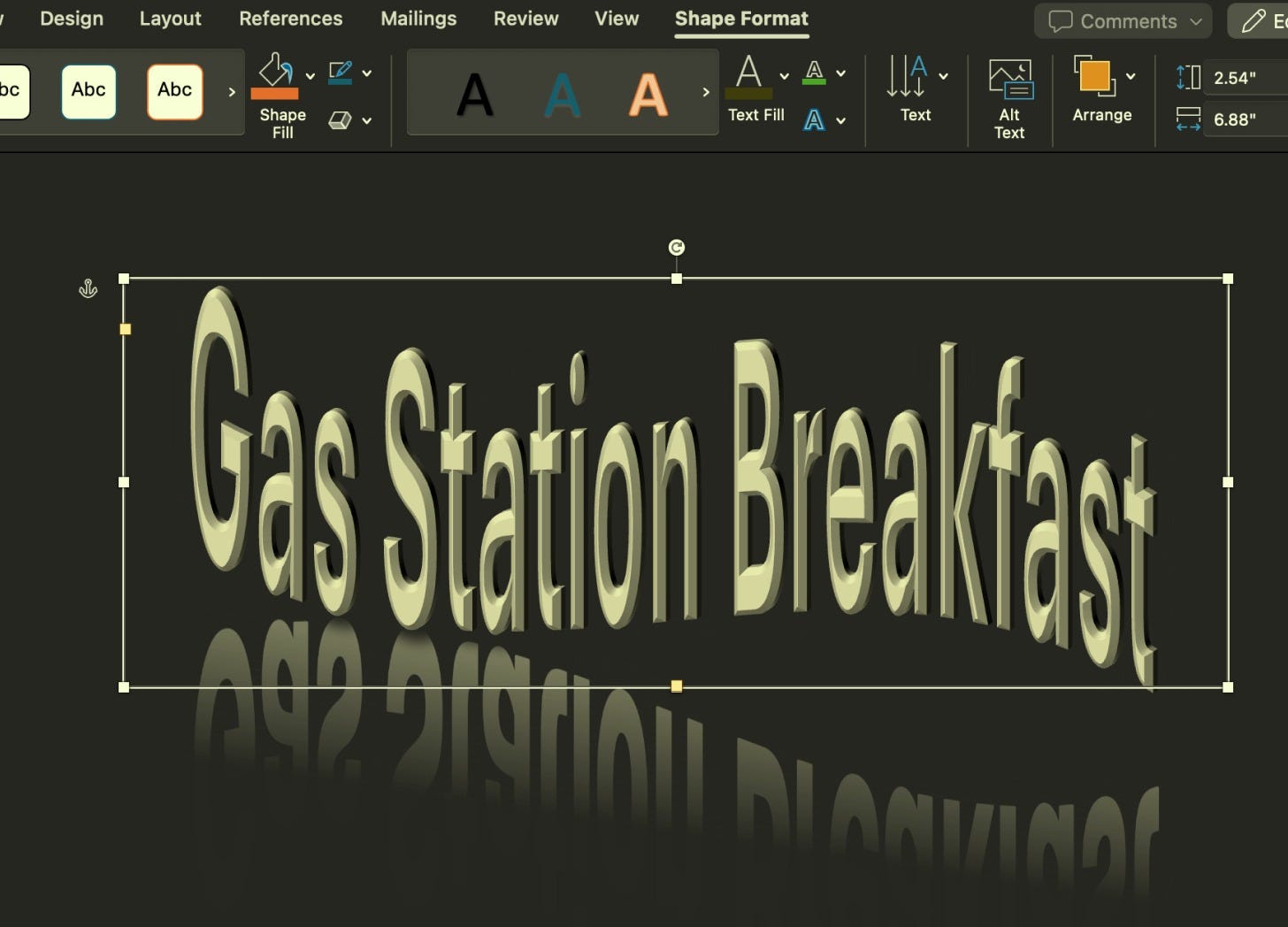
In 2012, a French academic documented what happened when Microsoft handed graphic design to everyone. The profession’s middle collapsed, the amateurs couldn’t see the difference, and the survivors invented a playbook. Every knowledge worker now facing AI is living inside that paper, and almost nobody has read it.

AI Key Takeaways
Pierre Braun’s study of the WordArt era is the closest thing knowledge work has to a controlled experiment in democratization: one feature, one profession, a decade of observable consequences.
The findings: amateurs produced work they genuinely believed was professional, validated each other inside closed loops, and the market for competent-but-ordinary design collapsed.
The survivors shared one strategy: work that could not be replicated through standard tools, from hand-carved type to radically conceptual practice.
AI reruns the experiment at internet scale, across every knowledge profession simultaneously, compressed from a decade into a few years, with the same three dynamics already visible.
The precedent’s real lesson concerns the amateurs’ blindness: when buyers can’t perceive quality, only legible, unreplicable difference gets paid.
Thirteen years ago (uh, uh…), I encountered a French academic paper that stayed with me: Pierre Braun’s Tout le monde est-il graphiste? (is everyone a designer?) Written in 2012, it documented what happened when Microsoft added WordArt to Word, and how it transfered desktop publishing into the hands of millions of people with no design training. I’ve cited it in passing many times. It deserves the full treatment now, because the paper turns out to have been a rehearsal script, and every knowledge profession is currently performing the play.
The experiment
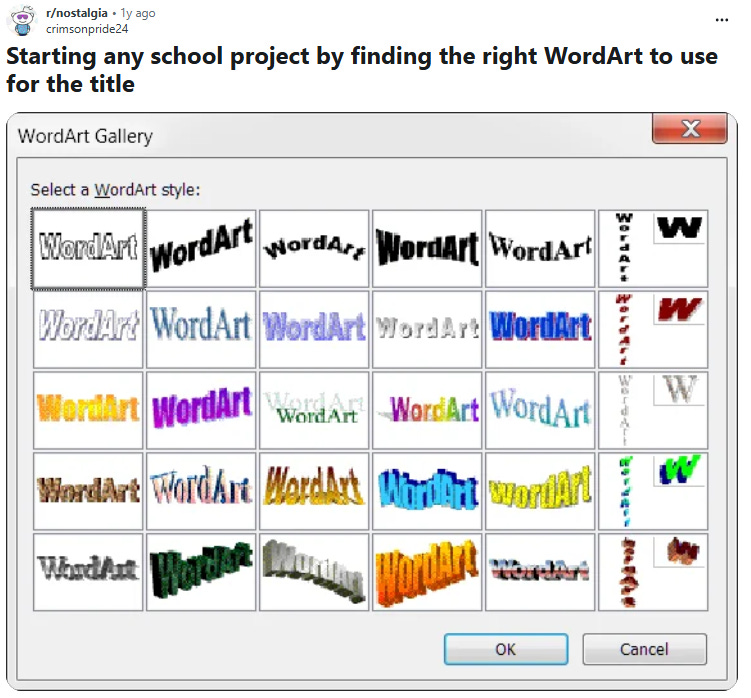
WordArt was a small feature: bent, shadowed, rainbow-filled display type, one click away, inside the software everyone already owned. With it, and with the consumer publishing tools around it, millions of non-designers began producing “professional” graphics: church bulletins, school newsletters, small-business flyers, the entire visual undergrowth of ordinary life.
Braun did what almost nobody does with a democratization wave: he studied it empirically. He collected the amateur output, interviewed its makers, and traced the economic consequences. Three findings matter.
The amateurs could not see the gap
Braun’s interviewees sincerely believed their work was professional grade. The competence needed to perceive the difference between their output and trained work was the same competence they lacked, so the difference was invisible to them by construction.
The blindness was social
Amateur designers validated each other inside what Braun called closed loops within “cultural microcosms”: communities where everyone shared the same untrained eye, so the group’s standard confirmed itself. He documented “an enormous import/export operation of templates without justified relationship to their use”: borrowed forms, applied without the judgment that had originally motivated them, circulating as if the forms themselves were the design.
The middle collapsed and the edges survived
Commodity design work went to the amateurs and their tools, and the professionals whose value had been reliable competence (better than nothing, cheaper than exceptional) lost their market. The survivors were the ones whose work could not be replicated through standard tools. Braun’s examples run from craft (a gallery identity built from hand-carved stamps and aggressive manipulation) to concept: Paul Elliman’s typefaces assembled from found objects, nails, bottle caps, debris, each letterform usable exactly once. You cannot template a practice whose entire content is that it can’t be templated.
The rerun, at scale
Map the three findings onto the present and the correspondence is uncomfortably exact.
The perception gap is now the 60% Baseline (my own framework, you can read about it here) : models produce output most stakeholders cannot distinguish from expert work, in writing, analysis, code, and design at once. The closed loops are now organizational: the executive who generates a strategy deck, shows it to peers also using AI, and receives validation from a room that has collectively lost its calibration. I’ve called this the organizational Dunning-Kruger effect, and Braun saw its folk version in the church-bulletin communities of the 1990s. And the collapse of the middle is running in the employment data in real time: demand concentrating at the senior end, the executional rungs dissolving, the “reliably adequate” tier discovering that adequacy has no buyer.
The differences are scale and speed, and they cut against comfort. WordArt was one feature, in one application, affecting one profession, over roughly a decade: a few thousand careers, adjusting slowly. The current wave covers every knowledge profession simultaneously and compresses the adjustment into a few years. The play is the same; the theater is the entire economy, and the acts change faster.
Reading the precedent correctly
The tempting reading of Braun is craft romanticism: be excellent and you’ll survive. The paper’s actual lesson is colder and more useful, and it concerns the buyers. The amateurs’ blindness means quality alone protects no one, because quality that buyers cannot perceive does not exist economically. The WordArt survivors made work whose difference was legible to untrained eyes precisely because it visibly could not have come from the standard tools. Hand-carved stamps read as hand-carved. Elliman’s bottle-cap letters read as unrepeatable. The survival strategy was never excellence in general. It was unreplicable difference, made obvious to people who can’t judge quality.
That’s the sentence I’d have every professional facing the current wave write down, because both halves are mandatory and most survival advice includes only one. Deep skill invisible to buyers is craft charity. Visible difference without the underlying depth gets absorbed the moment the tools catch up, and the tools are catching up quarterly.
Braun published into near-silence; democratization’s losers rarely commission histories. But the paper stands as the precedent document for the largest labor transition of our lifetimes, and its final implication is the one I keep arguing from every angle: when the tools make everyone a producer, the scarce things left are the judgment to know what’s worth producing, and the legibility to make that judgment visible to people who will never be able to evaluate it. Design ran this experiment first and wrote down the results. Everyone else gets to choose whether to read them.
NA: AI-assisted tools were used for transcription, reference formatting, and language editing. All intellectual content and conclusions remain solely the author’s.