



AI Key takeaways
The argument against AI art being real art is the wrong one. No point trying to define what is art and what is not, by picking out the tool or the process.
The data is not the problem. Training on existing work is how every artist in history has learned. Scale is different, but the principle is not.
We are lying to ourselves if we say that society has a universal moral objection to unauthorized IP appropriation. Art history shows us that’s not true.
The tool is not the problem either. We have never held that the instrument defines the value of the work. Effort is not a legal argument.
The real competition is economic, not artistic. This is a different conversation.


Index
Is the problem the data?
Is the problem the tool?
So is there a problem?
Artists hates AI-generated art. ‘AI artists aren’t real artists.’
The arguments have gone mainstream: prompting is not creating, how could it be? It’s effortless! Demands no skills! The tool does everything. And worse: it’s built on stolen works from real artists. It’s amoral! Art is virtuous! Really, most people agree, AI art, it’s not art.
I will argue that this first argument is wrong, and that the second is irrelevant.
Art has always used new tools, always sampled, and every time we as a society questioned the value of the result, we ended up recognizing it as progress and celebrated it.
Yes, intellectual property laws will be useful, but not to define if something is original art. Laws never defined what art is, but to decide who gets paid. IP infringement means nothing at the systemic level.
By definition, it is art. If it walks like a duck…
So why the malaise?
Is the problem the data?
AI models have been trained on publicly accessible data. Billions of images, texts, and recordings, scraped from the internet and fed into systems that learned patterns from them. That happened. It cannot be undone.
And honestly, it’s not a big deal.
I would push and even argue that this is, at its core, how any artist trains.
The process is not the problem. Every painter studied other painters. Every musician listened to other musicians. Every writer read other writers. The learning happened by absorbing what existed, internalizing patterns, and producing something informed by that absorption. The scale is different. The mechanism is different. A model processes data at a volume no human could match in a lifetime. As long as that knowledge sits inside a model and nobody is profiting from unlicensed output, it is sampling. Industrial-scale, technologically unprecedented sampling, but just sampling.
If a single, avant-garde artist spent 10 years hand-coding a machine to ingest the entire history of art and spit out syntheses, the art world would likely celebrate it as a profound commentary on human culture, memory, and creation.
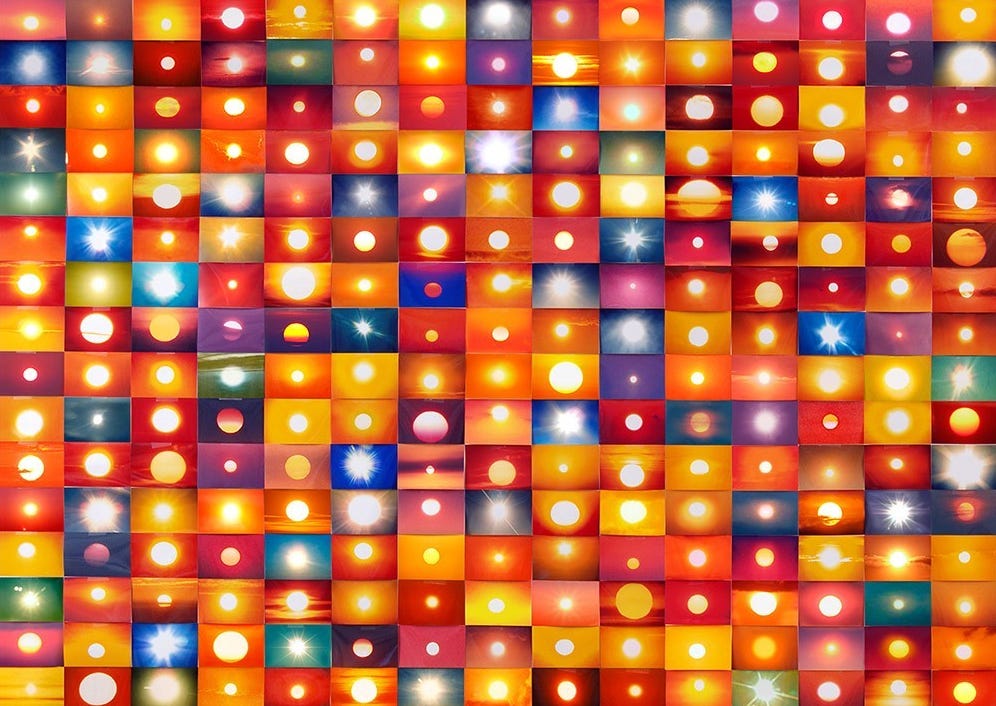
In 2006, Penelope Umbrico searched the photo-sharing site Flickr for the word “sunset.” At the time, she found over 500,000 results (which were the personal, copyrighted photos of everyday users). She downloaded thousands of these photos without asking for permission, cropped just the suns out of them, and printed them as massive, physical collages.
Umbrico’s work was celebrated as brilliant conceptual art. She took the digital “noise” of millions of people’s individual creations and aggregated them into a physical object.
When Umbrico scraped and sampled other people’s IP, the art world (eventually) defended them because their work was a critique. They were pointing a mirror at mass media, consumerism, and the internet.
When an AI company scrapes millions of copyrighted images to build Midjourney or Stable Diffusion, they are using the exact same underlying concept (massive, unauthorized appropriation of IP) but they are doing it to build a commercial utility.
Is the problem the tool?
If it’s not the data, maybe it’s the tool itself: the speed, the ease, the fact that something that once required years of practice can now be prompted in a sentence.
But we have never consistently held that the tool defines the legitimacy of the work. We just feel like it does when the tool is new and threatening. And what we are really objecting to, when we object to the tool, is the broken equation: effort equals value. We built that equation over centuries. It feels true. But it has never been legally enforceable, nor survived a major technological shift intact.
I wrote about the decorrelation between effort and value in a previous article. Check it out!
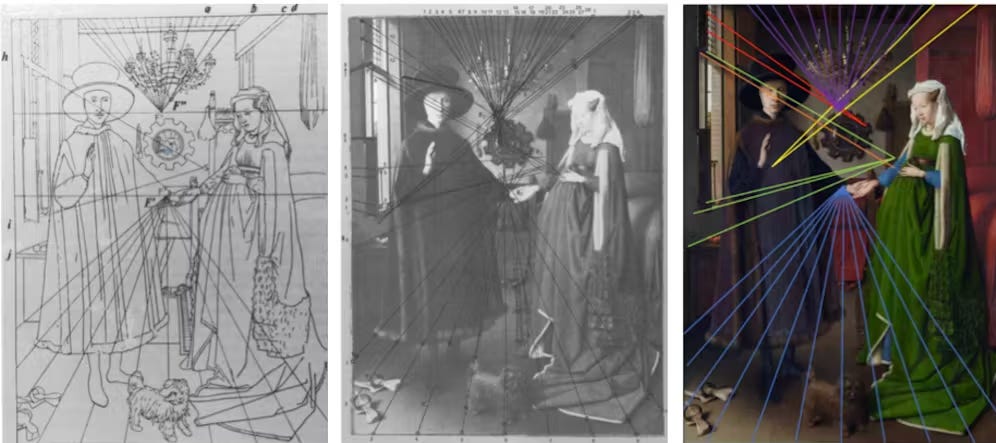
When does the tool define the art?
How much human modification makes it a human work?
When Van Eyck used a camera obscura to trace compositions onto canvas, he didn’t invent the scene. He used a mechanical device to project reality onto his surface and painted over it. We don’t discount his authorship.
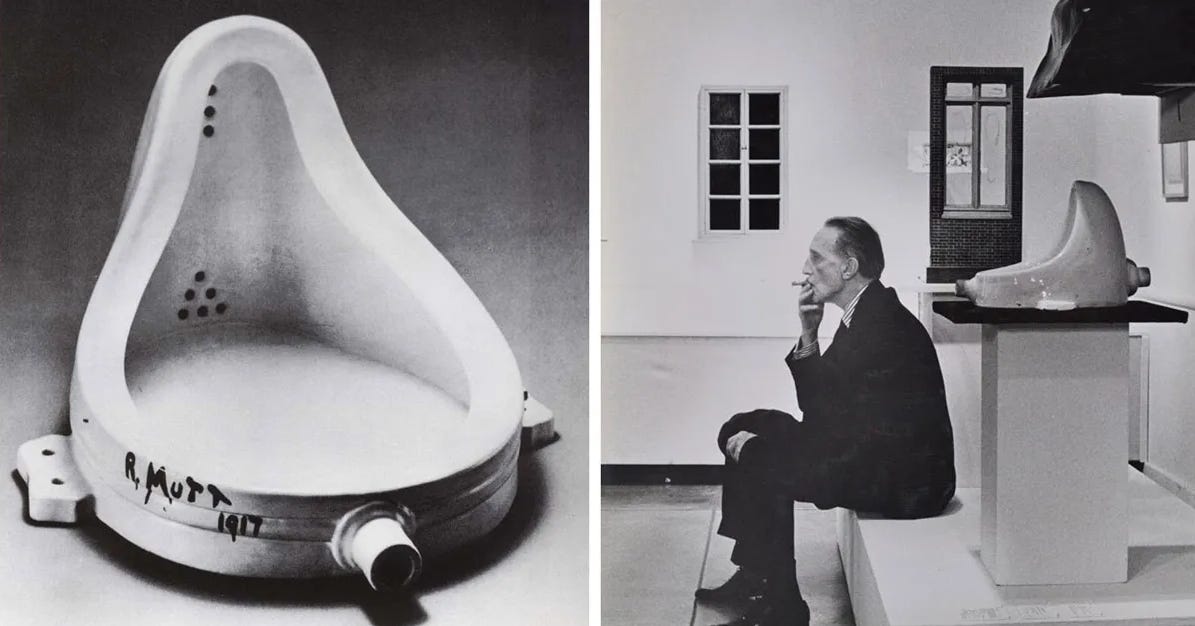
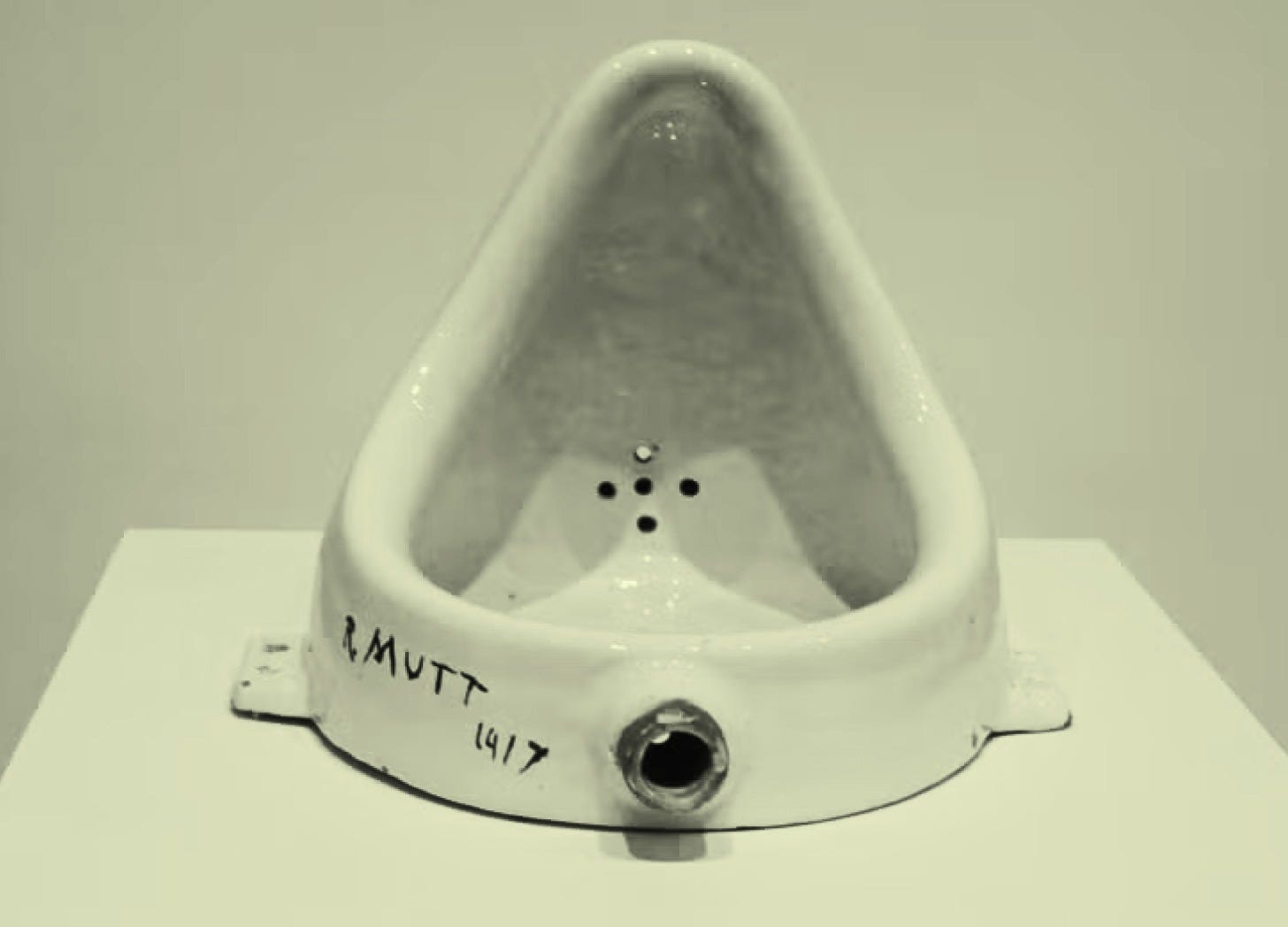
In 1917, Marcel Duchamp bought a porcelain urinal from a plumbing supply company, turned it on its side, signed it “R. Mutt,” and submitted it to an art exhibition.
Fountain became arguably the most important piece of contemporary art in the twentieth century. Duchamp didn’t fabricate the object. He selected it, recontextualized it, and declared it art.
The creative act was the decision, not the manufacture. If a readymade is art, then the question of what constitutes human authorship when tools do the fabrication is not new. We have been arguing about it for over a century. We just haven’t had to argue about it at this scale.
If we don’t discount Van Eyck’s authorship because he traced with a camera obscura, and if we accept that Duchamp’s creative act was the decision rather than the manufacture, then the discomfort with AI as a tool is a cultural argument.
A DJ didn’t replace the violinist. Electronic music created a different discipline with different skills, different outputs, different audiences. Both involve music. Both benefit from musical knowledge. They are fundamentally different crafts. Nobody serious argues that turntables made string instruments obsolete.
Yes, prompting is creating. Art history tells us there is nothing to debate here.
So is there a problem?
If it’s not the data, and it’s not the tool, but the discomfort is that acute, well, it needs a different explanation.
Society doesn’t actually have a universal, moral objection to mass, unauthorized IP appropriation. The problem begins at the point where training becomes commercial output. Where sampling stops being learning and starts being competition: not artistic competition, but economic competition.
The person who prompts an image generator and the person who paints on canvas are not fighting over the same artistic territory. They are fighting over an economic one. But because we lack the frameworks to separate them clearly, the confusion persists and the anger stays hot.