


The most vertically integrated company on earth looked at frontier AI, ran the math, and rented.
The build-vs-rent line runs through differentiation: Apple rented the model and kept the interface, the servers, and the customer relationship, because those are the layers that distinguish the product.
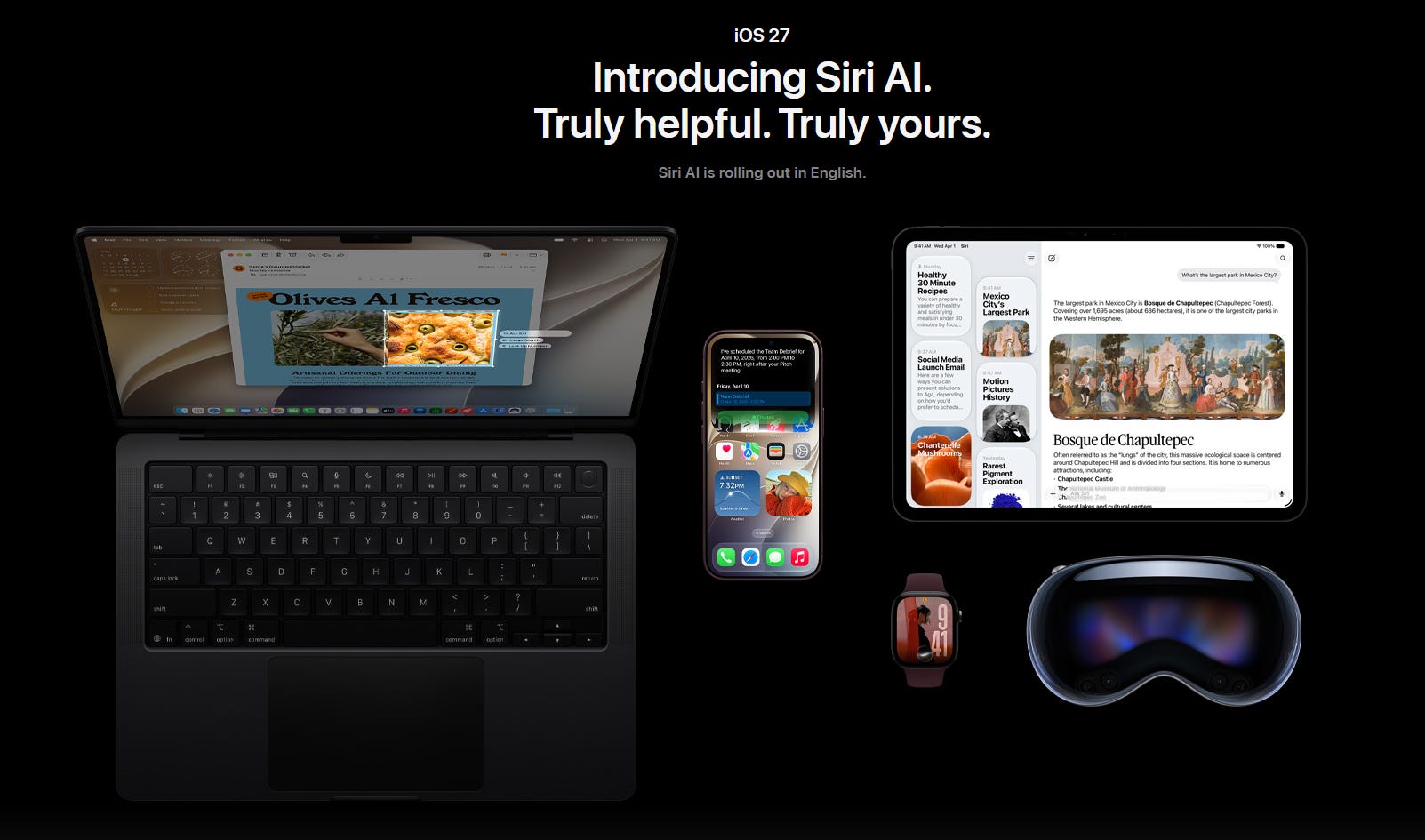
I wrote this in June; iOS 27 shipped in September and confirmed it, with one condition added on top of it: the rent looks like a bridge Apple built while developing its own model.

AI Key Takeaways
The facts: Apple based its next foundation models and the rebuilt Siri on Google’s Gemini, for about $1 billion a year, after weighing Anthropic’s costlier terms. iOS 27 delivered the full integration on September 14, 2026.
Rules one and three confirmed: frontier intelligence is now a procurement category, and the comparison-shopping that decided between Gemini and Claude is the proof at scale.
Rule four gained a condition: Apple is reportedly developing its own trillion-parameter model to replace Gemini, which reframes the deal as a designed bridge, not a permanent dependency.
Rule two is under live test: Apple’s privacy reassurances about Gemini query routing have not been backed by granular disclosure, and the gap is acknowledged as of iOS 27’s ship date.

In January 2026, a joint statement from Google and Apple announced a multi-year collaboration: the next generation of Apple Foundation Models would be based on Gemini, after Apple determined that Google’s technology offered “the most capable foundation.”
Bloomberg had reported that Apple would pay roughly $1 billion a year for a custom 1.2-trillion-parameter Gemini model, run on Apple’s own servers. At WWDC in June, Apple unveiled the rebuilt Siri. The final version shipped on September 14, with iOS 27, closing an eight-build beta cycle.
I recently had written about what this means for the model layer in FAANG had an A for Apple. MANGO doesn’t.
This teardown is for decision-makers, because the deal’s structure holds four rules that apply to every company agonizing over build versus rent. This article was drafted in June, now we had four months of evidence to stress it.

Rule one: vertical integration ends where utilities begin
Apple has always known exactly where to stop integrating.
It builds chips because chip decisions differentiate iPhones. It leaves power plants to others, though it consumes gigawatts, because electricity is a utility: uniform enough that owning production adds no distinguishable value to the product.
The Gemini deal files frontier intelligence in the utility column. The judgment is that model capability has become uniform enough across the frontier that owning production no longer differentiates the product it powers.
The transferable question for any company: for each capability on the build list, would owning production make the product distinguishable to a customer, or would it only make the cost structure heavier? Apple’s answer for intelligence was the second, and so far, few companies have answered that question better.
Four months later, the September rollout ran the test: iOS 27 has shipped on schedule. 1.5 billion daily users updated to a Siri running on a rival’s model, and the product held. Turn out, the utility classification was correct.

Rule two: the line runs through differentiation
Apple Intelligence continues to run on Apple devices and Private Cloud Compute, under Apple’s privacy architecture, behind Apple’s interface, inside Apple’s device and wrapped in Apple’s brand.
Everything a customer touches, and everything a customer could attribute to Apple, stayed owned. The rented component is the one no user experiences directly.
As of iOS 27’s ship date, the privacy side of this rule is under live test. Apple’s position is that Gemini queries route through its own Private Cloud Compute and are not used to train Google’s models.
Apple has not yet published granular disclosure about how personal data travels between those layers. For companies applying rule two, this is the stress point: owning the behavior is one thing, demonstrating that you own it is another.
Trust in a rented stack is either built or lost.

Rule three: comparison-shopping is the commoditization tell
Apple tested Anthropic before choosing Google. Bloomberg’s Mark Gurman later said Apple had planned to rebuild Siri around Claude, and that Anthropic wanted “several billion dollars a year”, at a price that doubled every year for three years. A company that puts two frontier vendors side by side, scores them, and lets the terms decide is performing procurement, and procurement is how buyers treat commodities.
“Anthropic was holding them over a barrel.”
Mark Gurman, Bloomberg, January 2026
When a team evaluates model vendors, does the decision come down to capability gaps, or to price and terms? Once it comes down to price and terms, the strategic question is absolutely settled: the company is buying a utility, and every dollar of engineering spent duplicating it internally builds a private power plant to run the same lightbulbs.
With 1.5 billion daily users now running on the model Apple chose by procurement while the confirmation is at scale. No capability gap separated Google from Anthropic in Apple’s final decision.

Rule four: renting from a rival is survivable when the moat is elsewhere
The objection to the deal writes itself:
Apple has handed a dependency to its most direct competitor.
But, Google historically finances Apple research department. It paid Apple $20 billion in 2022 to be the default search engine in Safari, according to court documents in the Justice Department’s antitrust case. Apple now returns a slice of that to rent Google’s model. Each company holds a hostage.

Apple depends on Google’s intelligence, and Google depends on Apple’s distribution, which is the layer Apple kept.
We see this pattern in older industries, for example Boeing sells to rival airlines, banks share payment rails with competitors, and everyone survives because competition moved long ago to layers the shared machinery leaves untouched.
Looking back now, Apple is reportedly developing its own trillion-parameter model that could replace Gemini as soon as late 2027. That reframes the deal’s reading. In June, renting from a rival read as a calculated acceptance of dependency, survivable because the moat sits elsewhere.
In October, it reads as a bridge: a way to ship a competitive Siri on a rival’s weights while Apple builds its own production capacity. Google collected rent on infrastructure Apple planned to own.
For companies applying rule four, this adds a condition: the survivability of renting from a rival depends on whether the moat sits elsewhere, and it depends on whether the exit is already in the plan. A rent with no planned exit becomes a structural position and a dependency.

So far, so good
There are limits: Apple’s rules transfer cleanly to companies whose differentiation was never the model, aka nearly every enterprise, retailer, bank and hardware maker. They stop at companies whose product is the frontier (the labs themselves), and at domains where model behavior is the regulated substance and owning the weights is a compliance requirement.
The deal’s second act is already (partly) written now. A Siri arriving two years late on a rival’s model shipped on time and works. What remains open is the privacy architecture under pressure, and whether Apple’s own model, when it ships, performs well enough to make the bridge worth being crossed.
Apple characteristically will not answer these questions before the product does.
So, here it is: the most integration-minded company in business history looked at frontier intelligence and bought it the way it buys electricity.
Four months of evidence suggest it planned to use the time to build its own plant once it understood what it was really needed.
NA: AI-assisted tools were used for transcription, reference formatting, and language editing. All intellectual content and conclusions remain solely the author’s.
Your October update quietly revises rule one. Nobody builds their own power station for a utility. If Apple is spending to replace Gemini by late 2027, it has decided intelligence isn’t electricity after all, at least not for a company that wants to stay Apple. The likely reason is in rule two: the rented layer stays invisible only while the product’s job is answering.
Once the job is understanding a particular person, the model’s behaviour is what they experience, and the privacy gap you flag stops being a footnote and becomes the product. Maybe the honest version of rule one is that frontier intelligence is a utility only for as long as you’re behind.