


This article is a direct follow-up to the previous one about how we We engineer humanity away

AI Key takeaways
The most valuable commodity is the proof of command over AI, defining the new verification economy
Trust is built on accountability and human consequences, not on accuracy alone
Ignoring human oversight creates a massive, unpriced liability gap as machines cannot be held accountable
Verification is an act of authorship by an expert, which serves as the only strategic differentiator in an AI-saturated market


Index
Trust is not a mathematical output
A future of liability risks
You can’t certify AI
Verification as strategy

We’ve reached a point where “good enough” content is free and infinite. Because it has detached technical ability from actual credibility, most organizations are currently obsessed with how to use AI more, but they’re missing the liability and strategic gaps opening up beneath them. In a market flooded with automated fluency, the best thing left to sell is the proof of command.
We are now living in a verification economy.
Trust is not a mathematical output
Organizations often mistake accuracy for trust. When a process breaks or a client becomes skeptical, the default corporate response is to provide more data, better benchmarks, higher accuracy: that is not why people buy professional services.
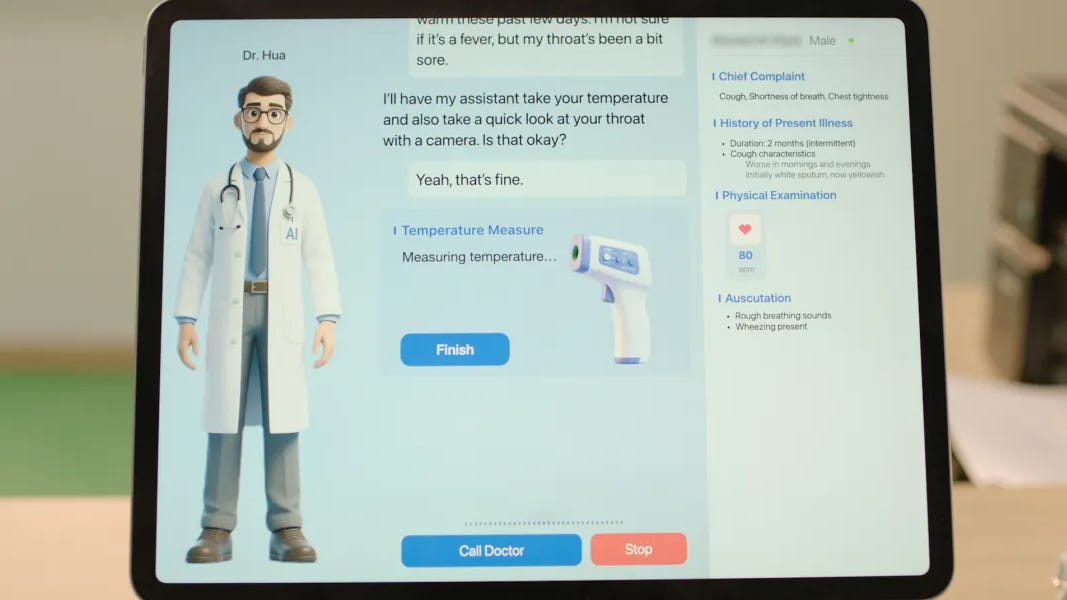
AI diagnostics outperform human doctors every time, yet patients hesitate to rely on them. This hesitation is grounded in a rational understanding of accountability. We trust doctors not because they are infallible, but because of the accountability infrastructure surrounding them: board certifications, malpractice liability, and revocable licenses.
Trust requires the presence of consequences.
A machine cannot be embarrassed, it cannot lose a reputation, and it doesn’t have skin in the game. Accuracy is a metric of production while accountability is a metric of risk. Clients do not pay for competence alone: they pay for the certainty that someone is responsible for the outcome.
A future of liability risks
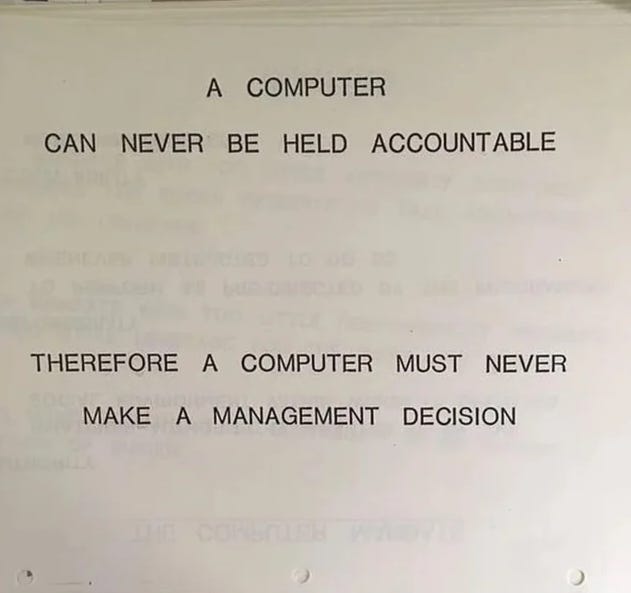
In 1979, IBM established a principle that remains the most relevant guideline for modern management: “a machine cannot be held accountable, therefore it must never make a management decision”.
Modern firms are currently ignoring this. AI is generating legal briefs, architectural calculations, and financial forecasts with very little meaningful oversight. This has created a massive, unpriced liability gap. As regulators move in and sophisticated clients begin to scrutinize procurement language, the question “Who reviewed this?” will become the primary hurdle for any contract.
Most firms are currently unable to answer that question. They operate on the assumption that grammatical fluency is a proxy for deep thought. In reality, fluency is now the default setting of the machine, and it no longer signals quality, nor reliability.
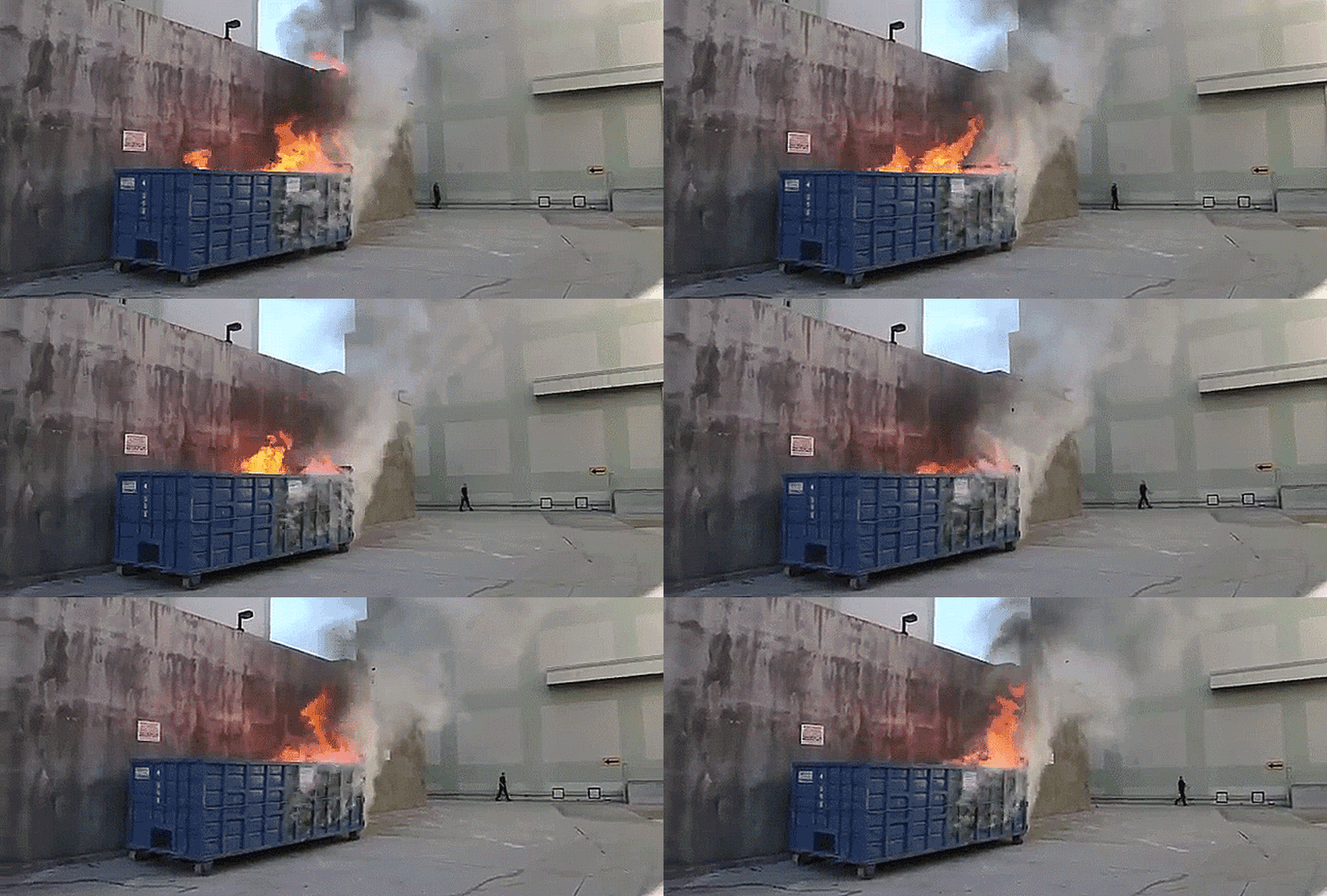
Control is trust. Deloitte learned the hard way. Twice. In the same year. First, an Australian government welfare report was found to contain fabricated AI generated citations, nonexistent footnotes, and a fabricated court quote. Then a Canadian healthcare report surfaced with similar issues.
“The use of standardized, cookie-cutter reports by consultants that are shopped to different municipalities with no regard for local context or history is yet another example that there often isn’t much substantive research or analytical rigour behind the curtain.”
— Canadian Centre for Policy Alternatives, December 2025 — CCPA
You can’t certify AI
As organizations recognize this trust deficit, many will reach for the familiar tools of the industrial age; you know them, you hate them: the periodic audit or the annual certification. This approach relies on an outdated logic where a certification serves as a backward-looking “stamp,” indicating that at a single point in time, a process met an external standard. In the context of AI, models and prompts generate infinite variations in real-time. A static marker is functionally useless.
True verification is an act of authorship, not process-following.
It requires an internal expert (a ‘liability sponge’) who understands the technology deeply enough to make informed choices rather than simply following a compliance checklist. This is a matter of ownership and technical competency.
Furthermore, while certification measures a firm against a shared external bar, verification measures a company against itself. Every decision in the AI pipeline (from data selection and prompt engineering to ponderation and reintegration) is a reflection of specific corporate values and strategic direction. These choices are not generic: as they cannot be audited by an outsider who doesn’t understand what the company stands for.
While quality ensures you didn’t deviate from a standard, verification ensures you didn’t deviate from yourself.
Verification as strategy
Credibility means showing you command your AI model: what went in, how it was shaped, who stood behind it. This requires a shift from human-as-producer to human-as-judgment. Not a retreat into nostalgia; but the recognition that judgment and accountability are inseparable from human stakes.
Verification is the economy sitting underneath the AI economy. The infrastructure that makes production viable. In a market where every competitor runs the same models to produce the same average results, the ability to demonstrate control is the only differentiator.
Reading this, I kept thinking about Covey’s 8th Habit — the idea of “voice” as the uniquely human intersection of talent, conscience, and contribution.
Your argument about command, verification, and accountability feels like the external architecture of that same idea. What’s scarce now isn’t just proof of command; it’s the human willingness to respond — to bring voice, not just output.
Machines can generate, but they can’t take responsibility. They can’t stand behind a choice. They can’t offer the kind of resilience that comes from a person deciding, “This is mine to answer for.”
In that sense, the verification economy is also a voice economy. The value isn’t only in what is produced, but in the human who shows up behind it.